- needhelp@company.com
- 92 888 666 0000
- 80 Golden Street USA



Blog Details
By Admin
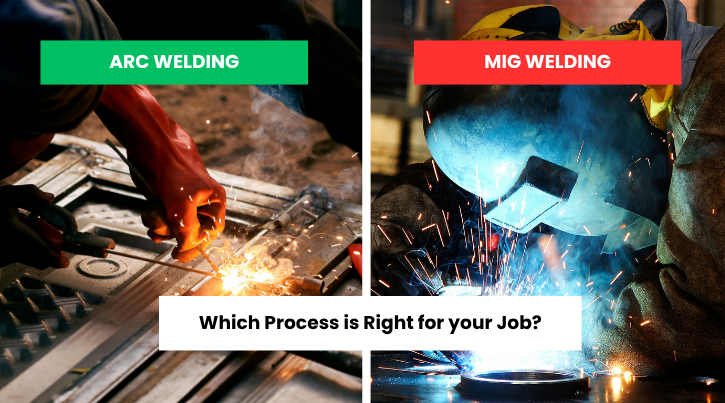
Arc Welding vs MIG Welding
Not All Welding Jobs Are the Same
Imagine two workshops working on different projects.
One is repairing a heavy-duty construction equipment frame on-site. The other is manufacturing metal components in a fabrication shop with tight production deadlines.
Both need strong welds. Both need reliable results.
But they don't necessarily need the same welding process.
This is where understanding the difference between Arc Welding and MIG Welding becomes important.
Choosing the wrong process can lead to:
- slower production
- excessive rework
- poor weld quality
- higher consumable costs
Choosing the right process improves productivity, weld quality, and overall project efficiency.
In this guide, we'll explain the key differences between Arc Welding and MIG Welding in simple terms and help you understand which process is best for your application.
What is Arc Welding?
Arc Welding, also known as Shielded Metal Arc Welding (SMAW), uses a consumable welding electrode (welding rod) to create an electric arc between the rod and the metal surface.
The heat generated by the arc melts both the electrode and the base metal, creating a strong weld joint.
Arc Welding is one of the most widely used welding methods in India due to its simplicity, portability, and versatility.
Common Consumable Used
🔩 Welding Electrodes (Welding Rods)
Popular classification:
- E6013 Welding Rods
What is MIG Welding?
MIG Welding, also known as Gas Metal Arc Welding (GMAW), uses a continuously fed welding wire and shielding gas to create the weld.
Unlike Arc Welding, the wire is automatically fed through a welding gun, making the process faster and more efficient.
MIG Welding is commonly used in fabrication shops and manufacturing environments where speed and consistency are important.
Common Consumable Used
⚙ MIG Welding Wire
Popular grade:
- ER70S-6 MIG Wire
Arc Welding vs MIG Welding: Quick Comparison
|
|
|
|
|
|
|
|
|
|
|
|
|
|
|
|
|
|
|
|
|
|
|
|
|
|
|
|
|
|
|
|
|
|
|
|
|
|
|
|
|
|
|
|
When Should You Use Arc Welding?
Arc Welding remains the preferred choice for many contractors and welders because it performs well in challenging site conditions.
Best Applications
✔ Structural fabrication
✔ Repair and maintenance work
✔ Construction equipment repair
✔ Heavy fabrication
✔ Outdoor welding projects
✔ Industrial maintenance
Advantages
Lower Equipment Cost
Arc welding machines are generally more affordable than MIG welding systems.
Easy to Transport
Ideal for:
- construction sites
- field repairs
- maintenance jobs
Performs Well Outdoors
Since Arc Welding does not depend on external shielding gas, it is less affected by wind and weather conditions.
When Should You Use MIG Welding?
MIG Welding is preferred when productivity and weld appearance are priorities.
Best Applications
✔ Fabrication workshops
✔ Sheet metal work
✔ Automotive fabrication
✔ Machinery manufacturing
✔ Production welding
✔ Industrial fabrication
Advantages
Faster Welding Speed
MIG welding can significantly improve production output compared to manual welding.
Cleaner Weld Finish
Produces:
- less spatter
- smoother weld beads
- reduced grinding requirements
Easier for Long Continuous Welds
Ideal for repetitive manufacturing environments.
Which Welding Process Is More Cost Effective?
Many people assume Arc Welding is always cheaper.
The reality is more nuanced.
Arc Welding
Lower:
- equipment cost
- setup cost
Higher:
- labor dependency
- electrode change frequency
MIG Welding
Higher:
- machine investment
- gas cost
Lower:
- labor time
- rework
- production cycle time
For fabrication shops handling large volumes, MIG Welding often delivers a better long-term return on investment.
What About Weld Quality?
Both processes can produce strong welds when:
- proper welding parameters are used
- skilled welders are involved
- quality consumables are selected
However, consumable quality plays a major role.
Poor Welding Consumables Can Cause:
❌ excessive spatter
❌ weak penetration
❌ porosity
❌ inconsistent weld quality
❌ increased rework
This is why many workshops now focus on using:
- BIS-certified welding rods
- reliable MIG welding wire
to maintain consistent results.
How to Choose the Right Welding Consumable
Regardless of the welding process, selecting the right consumable is critical.
For Arc Welding
Choose welding rods based on:
- material type
- thickness
- application
For general fabrication:
🔩 E6013 Welding Rods remain one of the most commonly used options.
For MIG Welding
Choose wire based on:
- material compatibility
- shielding gas
- production requirements
For mild steel fabrication:
⚙ ER70S-6 MIG Welding Wire is widely preferred.
Which Process Is Better for Indian Workshops?
The answer depends on the application.
Choose Arc Welding If:
✔ You work on construction sites
✔ You perform repair work
✔ You need portability
✔ You handle heavy fabrication
Choose MIG Welding If:
✔ You operate a fabrication workshop
✔ You require higher productivity
✔ You manufacture components regularly
✔ You need cleaner weld finishes
Final Thoughts
There is no single "best" welding process.
The best process is the one that matches:
- your application
- production requirements
- work environment
- quality expectations
Many successful workshops use both:
🔩 Arc Welding for repairs, structural work, and site applications
⚙ MIG Welding for fabrication, manufacturing, and production environments
The key is not just choosing the right process—but also choosing the right welding consumables.
Reliable welding rods and high-quality MIG welding wire help reduce rework, improve productivity, and create stronger welds.
Strong Welds Start with the Right Consumables
Whether you're welding on-site or inside a fabrication workshop, the quality of your consumables directly affects the quality of your work.
Karito Welding Solutions
🔩 Arc Welding Rods
⚙ MIG Welding Wires
🛡 BIS & ISI Certified
🏗 Designed for Real Workshop Conditions
📞 +91 9599 116 787
🌐 https://karito.co.in


